Kartoffelpüree Kalorien und Nährwerte
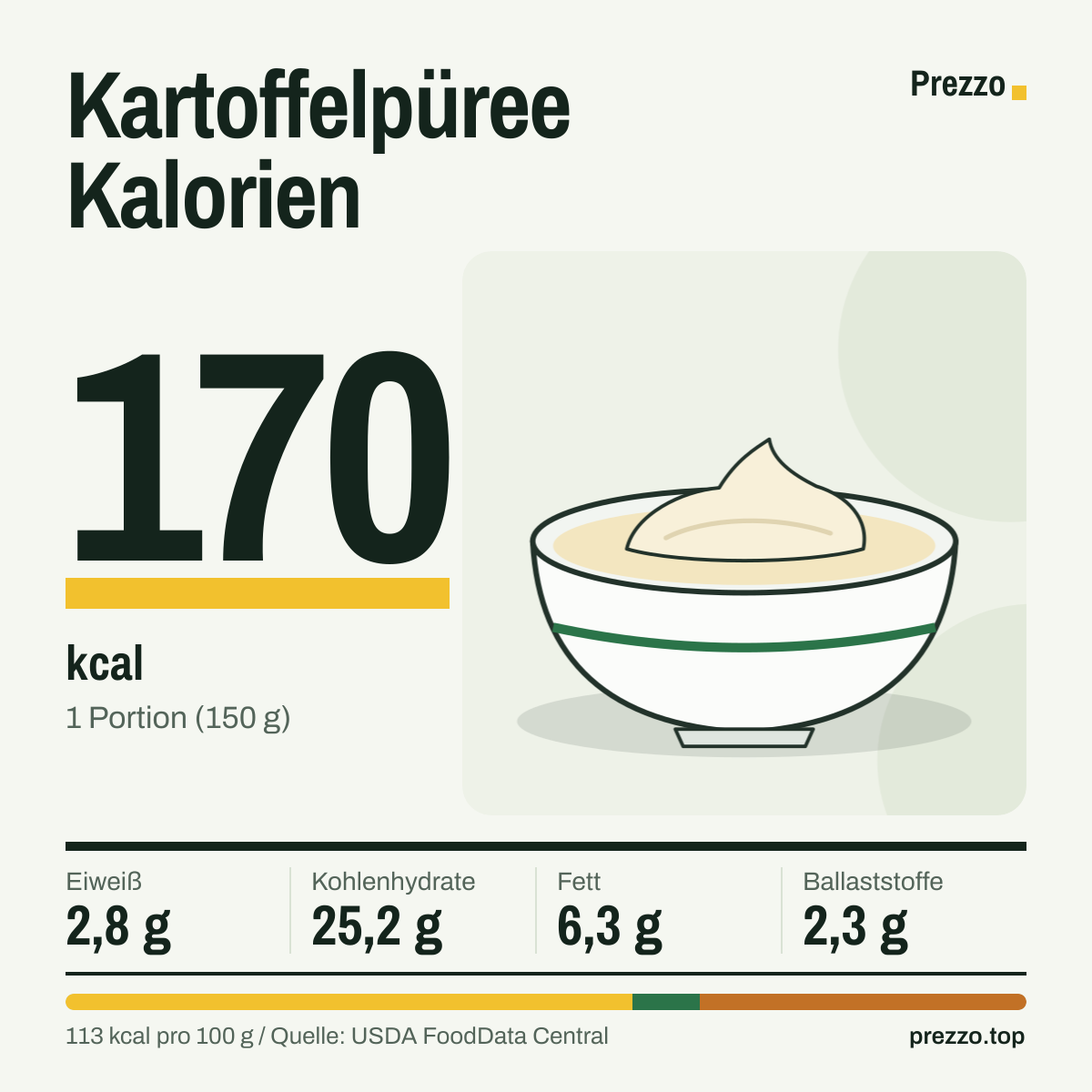
Wie viel Kalorien hat Kartoffelpüree? 1 Portion Kartoffelpüree (150 g) hat 170 kcal. Pro 100 g sind es 113 kcal, 1,9 g Eiweiß, 16,8 g Kohlenhydrate und 1,4 g Zucker.
Werte für Kartoffelpüree, aus USDA FoodData Central, SR Legacy (FDC 168555).
Portion wählen

Kalorien nach Portion
3 übliche Portionen: die kleinste ist „1 kleine Portion“ (113 kcal), die größte „1 große Portion“ (283 kcal). Die Gewichte sind Haushaltsmaße des USDA.
| Portion | Gewicht | kcal | Eiweiß | Kohlenhydrate | Fett |
|---|---|---|---|---|---|
| 1 Portion | 150 g | 170 | 2,8 g | 25,2 g | 6,3 g |
| 1 kleine Portion | 100 g | 113 | 1,9 g | 16,8 g | 4,2 g |
| 1 große Portion | 250 g | 283 | 4,7 g | 42 g | 10,6 g |
| 100 g | 100 g | 113 | 1,9 g | 16,8 g | 4,2 g |
So lange dauert das Verbrennen
Um 1 Portion Kartoffelpüree (170 kcal) zu verbrennen, braucht es etwa:
Für einen Erwachsenen mit 70 kg: Gehen mit 5 km/h, Radfahren mit 20 km/h, Laufen mit 10 km/h.
Kohlenhydrate liefern 59 % der Kalorien
Von den 113 kcal in 100 g Kartoffelpüree stammen etwa 59 % aus Kohlenhydraten, 7 % aus Eiweiß und 34 % aus Fett. Wir rechnen mit 4 kcal je Gramm verwertbarer Kohlenhydrate und Eiweiß, 2 kcal je Gramm Ballaststoffe und 9 kcal je Gramm Fett, wie es auch die Nährwertkennzeichnung tut.
Kartoffelpüree ist damit vor allem ein Kohlenhydratlieferant: 1 Portion Kartoffelpüree bringt 25,2 g Kohlenhydrate, davon 2,1 g Zucker. Eiweiß (2,8 g) und Fett (6,3 g) verändern die Summe von 170 kcal kaum.
Vitamin B6: 24 % der Referenzmenge pro Portion
1 Portion Kartoffelpüree (150 g) liefert 0,33 mg Vitamin B6, 24 % der Referenzmenge. Dazu kommen 426 mg Kalium (21 %) und 9 mg Vitamin C (11 %). Pro 100 g sind es 0,22 mg.
Die Werte gelten für Kartoffelpüree laut USDA-Analyse.
Fast keine der Kohlenhydrate sind Zucker
100 g Kartoffelpüree enthalten 16,8 g Kohlenhydrate: 1,4 g Zucker, 1,5 g Ballaststoffe und 13,9 g Stärke und andere Kohlenhydrate.
1 Portion Kartoffelpüree (150 g) liefert damit 23 g Netto-Kohlenhydrate (Kohlenhydrate abzüglich Ballaststoffe) und 2,3 g Ballaststoffe, 9 % der empfohlenen Tagesmenge.
Je 10 g kommen 11 kcal dazu
Kartoffelpüree hat 1,1 kcal pro Gramm, die Portionsgröße entscheidet also über die Summe. „1 kleine Portion“ (100 g) kommt auf 113 kcal, „1 große Portion“ (250 g) dagegen auf 283 kcal.
Wer abwiegt: 100 kcal Kartoffelpüree entsprechen etwa 88 g. 1 Portion Kartoffelpüree (150 g), die am häufigsten gesuchte Portion, hat 170 kcal.
Salz ist der Wert, auf den man achten sollte: 1,2 g pro Portion
1 Portion Kartoffelpüree (150 g) enthält 1,2 g Salz (476 mg Natrium), das sind 20 % der Referenzmenge von 6 g. Pro 100 g sind es 0,8 g Salz.
Das ist mehr als bei 25 der 115 anderen Gerichte auf dieser Seite. Zwei Portionen kämen auf 40 % der Tagesreferenz.
Im Vergleich mit ähnlichen Lebensmitteln
Kartoffelpüree im Vergleich mit ähnlichen Gerichte, pro 100 g.
| Lebensmittel | kcal | Eiweiß | Kohlenhydrate | Fett |
|---|---|---|---|---|
| Kartoffelpüree | 113 | 1,9 g | 16,8 g | 4,2 g |
| Kohlroulade | 114 | 8,3 g | 8,8 g | 5,1 g |
| Französische Zwiebelsuppe | 108 | 5,5 g | 11,8 g | 4,5 g |
| Chili con Carne | 107 | 5,8 g | 13,1 g | 3,5 g |
| Lachs-Nigiri | 107 | 8,9 g | 13,4 g | 1,7 g |
| Gulaschsuppe | 106 | 7,7 g | 8,4 g | 5,8 g |
Häufige Fragen
Wie viel Kalorien hat 1 Portion Kartoffelpüree?
1 Portion Kartoffelpüree (150 g) hat 170 kcal. 100 g haben 113 kcal.
Wie viele Kalorien haben 100 g Kartoffelpüree?
100 g Kartoffelpüree haben 113 kcal, 1,9 g Eiweiß, 16,8 g Kohlenhydrate und 4,2 g Fett.
Wie viele Kohlenhydrate hat Kartoffelpüree?
1 Portion Kartoffelpüree (150 g) hat 25,2 g Kohlenhydrate, davon 2,3 g Ballaststoffe, also 23 g netto. Pro 100 g: 16,8 g.
Welche Vitamine und Mineralstoffe hat Kartoffelpüree?
1 Portion Kartoffelpüree (150 g) liefert 0,33 mg Vitamin B6 (24 %), 426 mg Kalium (21 %) und 9 mg Vitamin C (11 %).
Wie viel Eiweiß hat Kartoffelpüree?
1 Portion Kartoffelpüree (150 g) hat 2,8 g Eiweiß. Pro 100 g: 1,9 g.
Macht Kartoffelpüree dick?
Kein einzelnes Lebensmittel macht dick oder schlank; entscheidend ist die Energiebilanz über die Zeit. Mit 113 kcal pro 100 g hat Kartoffelpüree eine mittlere Energiedichte, und 1 Portion Kartoffelpüree macht 8 % eines 2000-kcal-Tages aus. Allgemeine Information, keine medizinische Beratung.
Wie viel Salz hat Kartoffelpüree?
1 Portion Kartoffelpüree (150 g) hat 1,2 g Salz (476 mg Natrium). Pro 100 g: 0,8 g Salz.
Wie viele Ballaststoffe hat Kartoffelpüree?
1 Portion Kartoffelpüree (150 g) hat 2,3 g Ballaststoffe. Pro 100 g: 1,5 g.
Ähnliche Lebensmittel
Kartoffelpüree Kalorien auf einen Blick
Quellen und Methode
Nährwerte: USDA FoodData Central, SR Legacy, FDC 168555, abgerufen am 2026-11-18. Portionsgewichte: Haushaltsmaße von USDA und AUSNUT oder übliche Packungsgrößen. Prozentangaben beziehen sich auf die Referenzmengen der EU-Lebensmittelinformationsverordnung. Glykämischer Index: International Tables (Atkinson et al., 2021). So berechnen wir diese Werte