How Many Calories in Apple Juice?
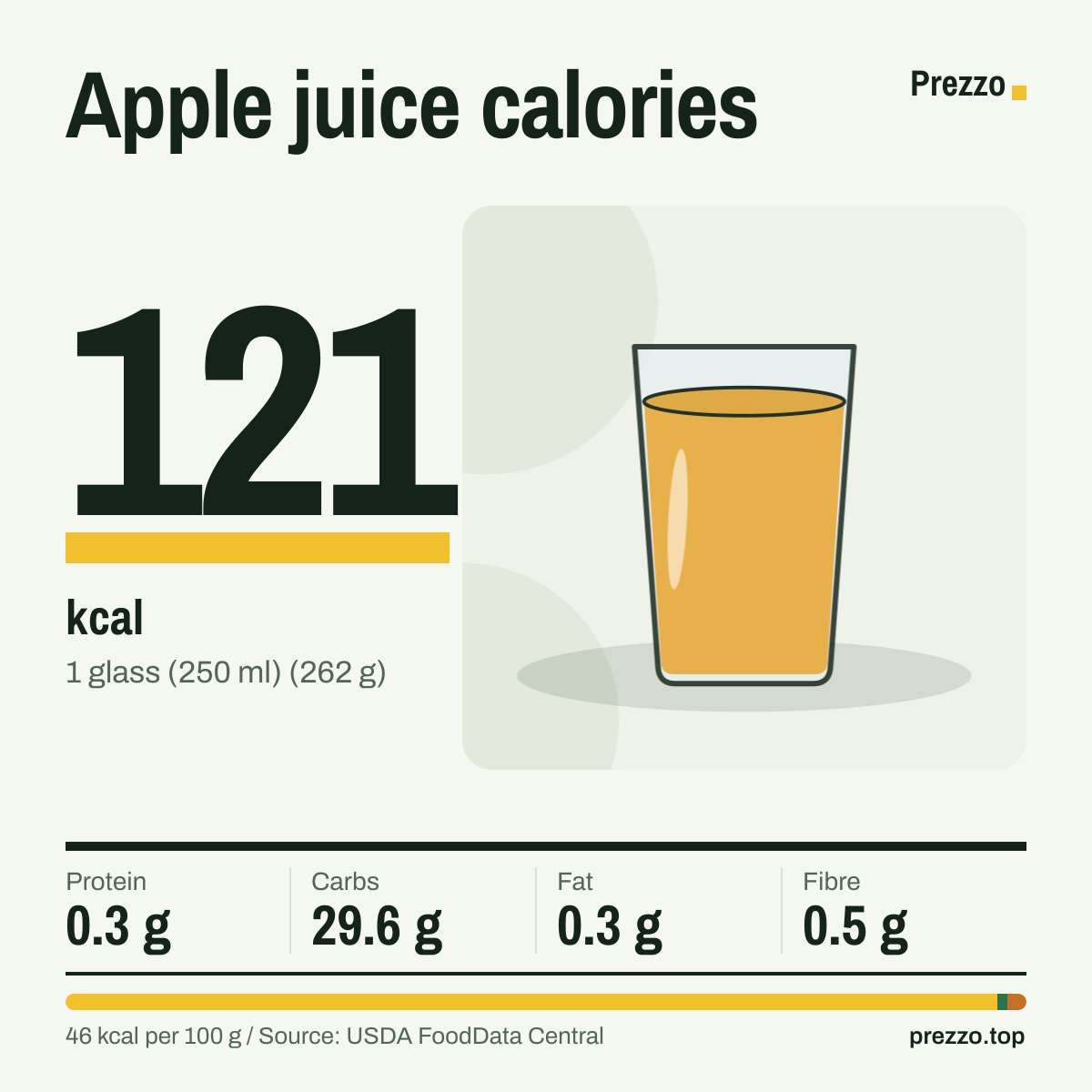
A glass of apple juice (250 ml) (262 g) has 121 kcal. Per 100 g that's 46 kcal, 0.1 g protein, 11.3 g carbs and 9.6 g sugar.
Values for apple juice, from USDA FoodData Central, SR Legacy (FDC 167771).
Choose a portion
Calories by portion
3 common portions of apple juice, from 100 ml (48 kcal) to 1 bottle (330 ml) (159 kcal). Weights are USDA household measures.
| Portion | Weight | kcal | Protein | Carbs | Fat |
|---|---|---|---|---|---|
| 1 glass (250 ml) | 262 g | 121 | 0.3 g | 29.6 g | 0.3 g |
| 1 bottle (330 ml) | 346 g | 159 | 0.3 g | 39.1 g | 0.4 g |
| 100 ml | 105 g | 48 | 0.1 g | 11.9 g | 0.1 g |
| 100 g | 100 g | 46 | 0.1 g | 11.3 g | 0.1 g |
How long to burn it off
Burning off a glass of apple juice (250 ml) (121 kcal) takes about:
For a 70 kg adult: walking at 5 km/h, cycling at 20 km/h, running at 10 km/h.
Carbs supply 97% of the calories
Of the 46 kcal in 100 g of apple juice, about 97% comes from carbohydrate, 1% from protein and 2% from fat. We count 4 kcal per gram of digestible carbs and protein, 2 per gram of fibre and 9 per gram of fat, the same factors food labels use.
That makes apple juice a carbohydrate food first: a glass of apple juice (250 ml) carries 29.6 g of carbohydrate, 25.2 g of it sugar. Protein (0.3 g) and fat (0.3 g) barely move the total of 121 kcal.
Vitamin C: 126% of the RI in 1 glass (250 ml)
A glass of apple juice (250 ml) (262 g) provides 101 mg of vitamin C, 126% of the reference intake. It also supplies 265 mg of potassium (13%). Per 100 g the vitamin C content is 39 mg.
Figures are for apple juice, as analysed by the USDA.
85% of the carbs are sugar
100 g of apple juice has 11.3 g of carbohydrate: 9.6 g sugar, 0.2 g fibre and 1.5 g of starch and other carbohydrates.
A glass of apple juice (250 ml) (262 g) therefore gives 29.1 g of net carbs (total carbs minus fibre) and 0.5 g of fibre, 2% of the reference intake.
Every 10 g adds 4.6 calories
Apple juice has 0.5 calories per gram, so the portion decides the total. 100 ml (105 g) comes to 48 kcal, while 1 bottle (330 ml) (346 g) reaches 159 kcal.
If you weigh your food, 100 calories of apple juice is about 217 g. A glass of apple juice (250 ml) (262 g), the portion most people look up, has 121 kcal.
Practically sodium-free: 4 mg per 100 g
A glass of apple juice (250 ml) (262 g) has 10 mg of sodium and 265 mg of potassium. Potassium outweighs sodium by roughly 25 to 1, the opposite of most processed foods.
Salt only becomes a factor if you add it or eat apple juice in a salted dish.
Compared with similar foods
Apple juice next to similar drinks, per 100 g.
| Food | kcal | Protein | Carbs | Fat |
|---|---|---|---|---|
| Apple juice | 46 | 0.1 g | 11.3 g | 0.1 g |
| Oat milk | 45 | 0.7 g | 5.4 g | 2.3 g |
| Iced tea | 45 | 0 g | 10.8 g | 0.2 g |
| Beer | 43 | 0.5 g | 3.6 g | 0 g |
| Latte | 43 | 2.8 g | 4.4 g | 1.6 g |
| Orange juice | 49 | 0.7 g | 11.5 g | 0.1 g |
Questions people ask
How many calories are in a glass of apple juice (250 ml)?
A glass of apple juice (250 ml) (262 g) has 121 kcal. 100 g has 46 kcal.
How many calories are in 100 g of apple juice?
100 g of apple juice has 46 kcal, with 0.1 g of protein, 11.3 g of carbohydrate and 0.1 g of fat.
How much sugar is in apple juice?
A glass of apple juice (250 ml) (262 g) has 25.2 g of sugar. 100 g has 9.6 g.
How many carbs are in apple juice?
A glass of apple juice (250 ml) (262 g) has 29.6 g of carbohydrate, including 0.5 g of fibre, so 29.1 g net carbs. Per 100 g: 11.3 g.
How much protein is in apple juice?
A glass of apple juice (250 ml) (262 g) has 0.3 g of protein. Per 100 g: 0.1 g.
What vitamins and minerals does apple juice have?
A glass of apple juice (250 ml) (262 g) gives 101 mg of vitamin C (126% RI) and 265 mg of potassium (13% RI).
Similar foods
Apple juice calories at a glance
Sources and method
Nutrient values: USDA FoodData Central, SR Legacy, FDC 167771, retrieved 2026-11-18. Portion weights: USDA and AUSNUT household measures or standard container sizes. Percentages use the EU/UK reference intakes. Glycemic index: International Tables (Atkinson et al., 2021). How we calculate these numbers