How Many Calories Are in Black Tea?
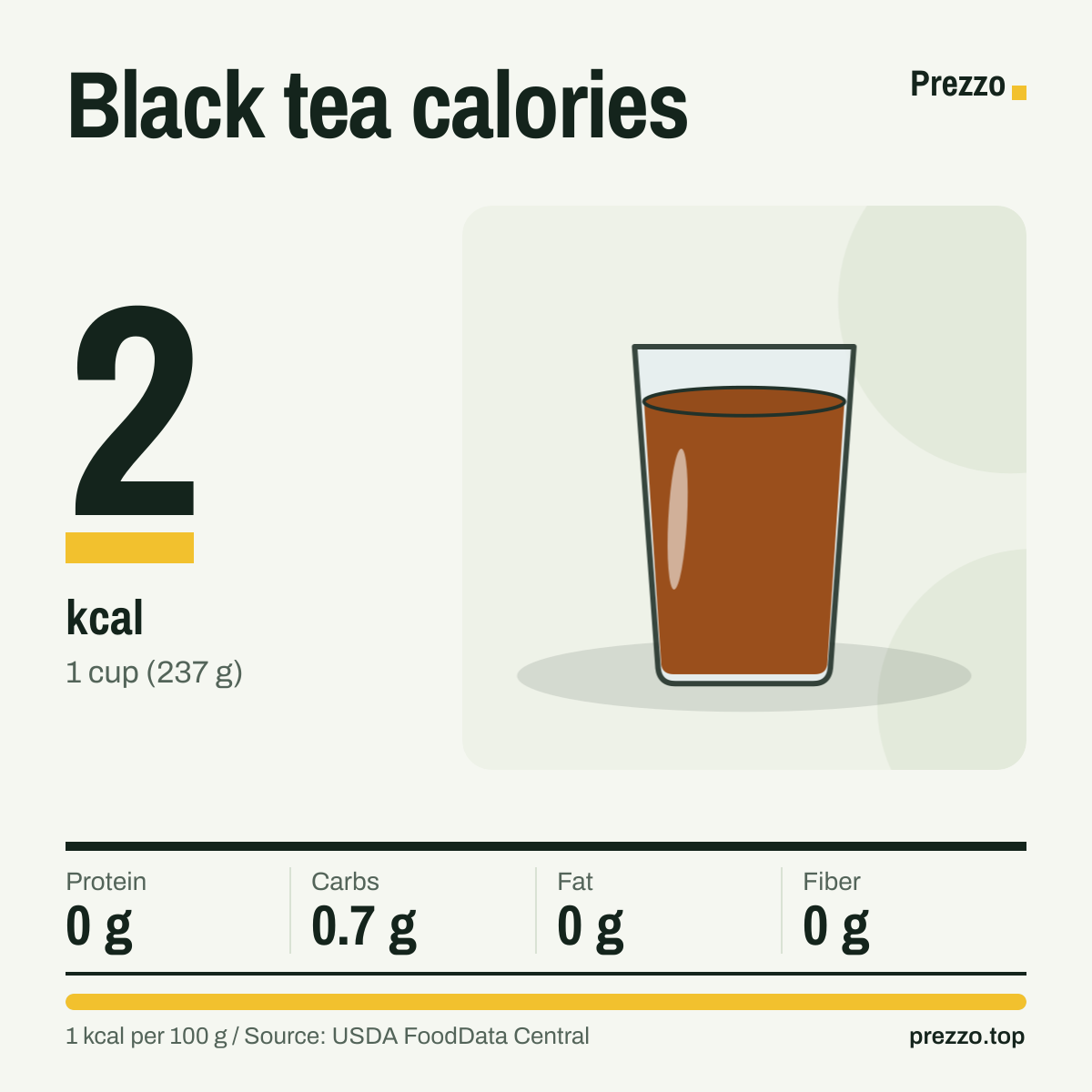
1 cup of black tea (237 g) has 2 calories. Per 100 g that's 1 calorie, 0 g protein, 0.3 g carbs and 0 g fat.
Values for black tea, from USDA FoodData Central, SR Legacy (FDC 173227).
Choose a portion
Calories by portion
3 common portions of black tea, from 6 fl oz (2 calories) to 12 fl oz (4 calories). Weights are USDA household measures.
| Portion | Weight | Calories | Protein | Carbs | Fat |
|---|---|---|---|---|---|
| 1 cup | 237 g | 2 | 0 g | 0.7 g | 0 g |
| 12 fl oz | 355 g | 4 | 0 g | 1.1 g | 0 g |
| 6 fl oz | 178 g | 2 | 0 g | 0.5 g | 0 g |
| 100 g | 100 g | 1 | 0 g | 0.3 g | 0 g |
How long to burn it off
Burning off 1 cup of black tea (2 calories) takes about:
For a 70 kg (154 lb) adult: walking at 3 mph, cycling at 12–14 mph, running at 6 mph.
Carbs supply 100% of the calories
Of the 1 calorie in 100 g of black tea, about 100% comes from carbohydrate, 0% from protein and 0% from fat. We count 4 kcal per gram of digestible carbs and protein, 2 per gram of fiber and 9 per gram of fat, the same factors food labels use.
That makes black tea a carbohydrate food first: 1 cup of black tea carries 0.7 g of carbohydrate, 0 g of it sugar. Protein (0 g) and fat (0 g) barely move the total of 2 calories.
Every 10 g adds 0.1 calories
Black tea has 0 calories per gram, so the portion decides the total. 6 fl oz (178 g) comes to 2 calories, while 12 fl oz (355 g) reaches 4 calories.
If you weigh your food, 100 calories of black tea is about 10,000 g. 1 cup of black tea (237 g), the portion most people look up, has 2 calories.
Practically sodium-free: 3 mg per 100 g
1 cup of black tea (237 g) has 7.1 mg of sodium and 88 mg of potassium. Potassium outweighs sodium by roughly 12 to 1, the opposite of most processed foods.
Sodium only becomes a factor if you add it or eat black tea in a salted dish.
Lower in calories than most drinks
At 1 calorie per 100 g, black tea ranks 1 of 66 drinks on this site, counted from the lowest. The group median is 54 calories per 100 g; the lowest is black coffee (1) and the highest Irish cream liqueur (305).
1 cup of black tea (237 g) is 0% of a 2,000-calorie reference day.
1 cup is 0% of a day's energy
Measured against the Daily Values for a 2,000-calorie diet, 1 cup of black tea (237 g) covers 0% of daily energy, 0% of protein, 0% of fiber and 0% of sodium.
Eaten twice a day, that becomes 0% of energy and 0% of protein. Individual needs vary with age, size and activity, so treat these as reference points rather than targets.
Compared with similar foods
Black tea next to similar drinks, per 100 g.
| Food | Calories | Protein | Carbs | Fat |
|---|---|---|---|---|
| Black tea | 1 | 0 g | 0.3 g | 0 g |
| Black coffee | 1 | 0.1 g | 0 g | 0 g |
| Green tea | 1 | 0.2 g | 0 g | 0 g |
| Diet cola | 2 | 0.1 g | 0.3 g | 0 g |
| Espresso | 9 | 0.1 g | 1.7 g | 0.2 g |
| Tomato juice | 17 | 0.9 g | 3.5 g | 0.3 g |
Questions people ask
How many calories are in 1 cup of black tea?
1 cup of black tea (237 g) has 2 calories. 100 g has 1 calorie.
How many calories are in 100 g of black tea?
100 g of black tea has 1 calorie, with 0 g of protein, 0.3 g of carbohydrate and 0 g of fat.
Is black tea good for weight loss?
No single food causes weight loss; your total energy intake over time decides it. At 1 calorie per 100 g, black tea has a low energy density, and 1 cup of black tea is 0% of a 2,000-calorie day. This is general information, not medical advice.
How many carbs are in black tea?
1 cup of black tea (237 g) has 0.7 g of carbohydrate, including 0 g of fiber, so 0.7 g net carbs. Per 100 g: 0.3 g.
How much protein is in black tea?
1 cup of black tea (237 g) has 0 g of protein. Per 100 g: 0 g.
Is black tea keto-friendly?
Yes. 1 cup of black tea (237 g) has only 0.7 g of net carbs, which fits easily into a typical keto limit of 20–50 g a day.
Similar foods
Black tea calories at a glance
Sources and method
Nutrient values: USDA FoodData Central, SR Legacy, FDC 173227, retrieved 2026-11-18. Portion weights: USDA and AUSNUT household measures or standard container sizes. Percentages use the FDA Daily Values (2,000-calorie diet). Glycemic index: International Tables (Atkinson et al., 2021). How we calculate these numbers