How Many Calories Are in Crab?
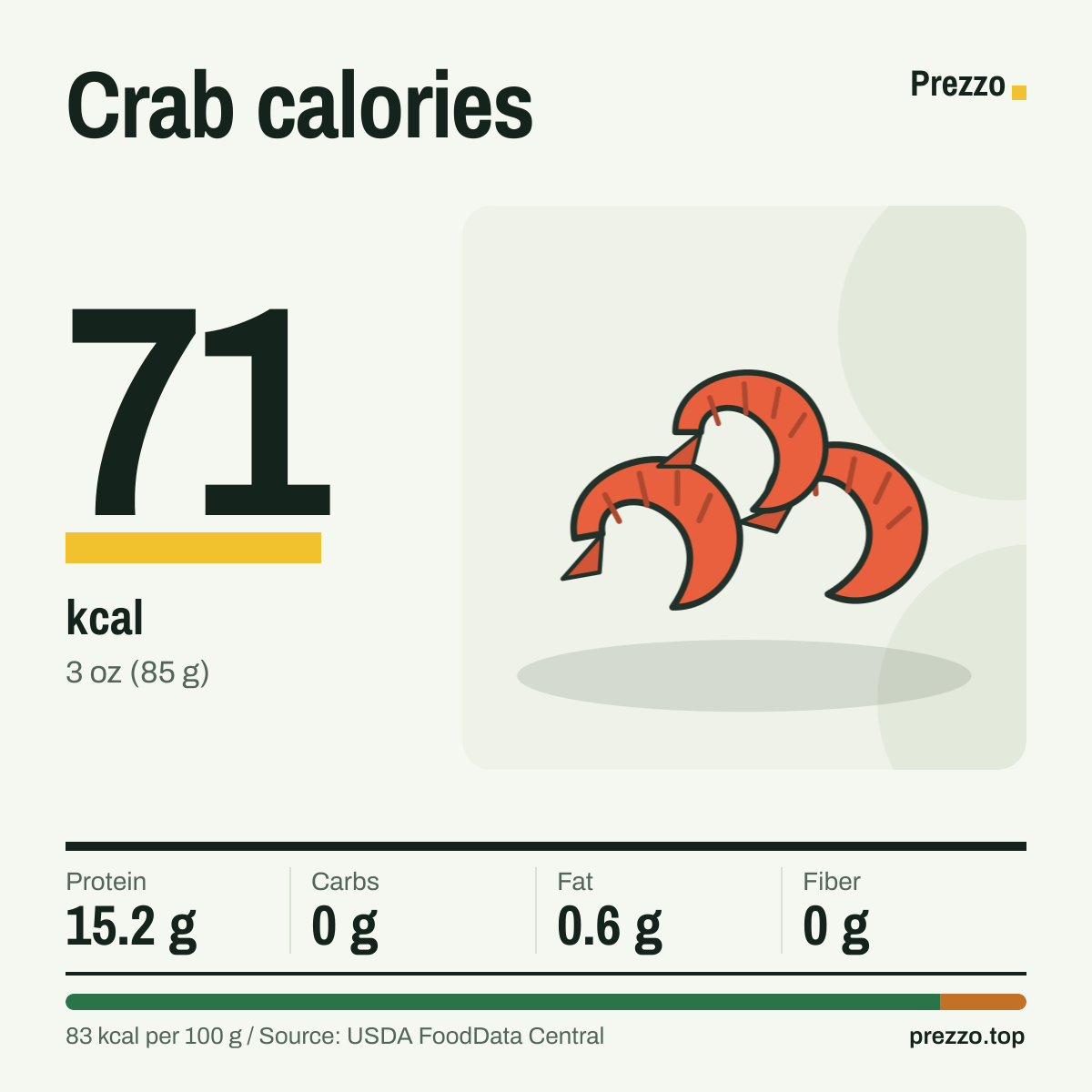
3 oz of crab (85 g) has 71 calories. Per 100 g that's 83 calories, 17.9 g protein, 0 g carbs and 0.7 g fat.
Values for cooked crab, from USDA FoodData Central, SR Legacy (FDC 174205).
Choose a portion

Calories by portion
3 common portions of crab, from 3 oz (71 calories) to 1 cup (112 calories). Weights are USDA household measures.
| Portion | Weight | Calories | Protein | Carbs | Fat |
|---|---|---|---|---|---|
| 3 oz | 85 g | 71 | 15.2 g | 0 g | 0.6 g |
| 1 cup | 135 g | 112 | 24.1 g | 0 g | 1 g |
| 4 oz | 113 g | 94 | 20.2 g | 0 g | 0.8 g |
| 100 g | 100 g | 83 | 17.9 g | 0 g | 0.7 g |
Preparation
The same food, prepared 2 ways. Values per 100 g and for 3 oz.
| Preparation | Calories / 100 g | 3 oz | Protein | Carbs | Fat |
|---|---|---|---|---|---|
| Cooked crab | 83 | 71 | 17.9 g | 0 g | 0.7 g |
| Raw crab | 87 | 74 | 18.1 g | 0 g | 1.1 g |
How long to burn it off
Burning off 3 oz of crab (71 calories) takes about:
For a 70 kg (154 lb) adult: walking at 3 mph, cycling at 12–14 mph, running at 6 mph.
Protein supplies 91% of the calories
Of the 83 calories in 100 g of crab, about 0% comes from carbohydrate, 91% from protein and 9% from fat. We count 4 kcal per gram of digestible carbs and protein, 2 per gram of fiber and 9 per gram of fat, the same factors food labels use.
That is an unusually lean profile: 3 oz of crab gives 15.2 g of protein for 71 calories, or 21.5 g of protein per 100 calories. Fat adds 0.6 g and carbohydrate 0 g.
Preparation changes the number: 83–87 calories per 100 g
Cooked crab has 83 calories per 100 g and raw crab has 87 calories per 100 g.
The gap between cooked crab and raw crab is 4 calories per 100 g, mostly from water: cooking, drying or soaking changes how much water each 100 g holds. Log the version you actually eat.
Vitamin B12: 118% of the DV in 3 oz
3 oz of crab (85 g) provides 2.8 µg of vitamin B12, 118% of the Daily Value. It also supplies 3.2 mg of zinc (29%) and 1.6 mg of vitamin E (10%). Per 100 g the vitamin B12 content is 3.3 µg.
Figures are for cooked crab, as analysed by the USDA.
15.2 g of protein in 3 oz
3 oz of crab (85 g) provides 15.2 g of protein, 30% of the Daily Value for protein. Per 100 g the figure is 17.9 g. Measured against energy, that is 21.5 g of protein for every 100 calories; among the meats and fish on this site, cecina has 37.3 g per 100 g.
Across common portions: 3 oz gives 15.2 g, 1 cup gives 24.1 g and 4 oz gives 20.2 g.
Every 10 g adds 8.3 calories
Crab has 0.8 calories per gram, so the portion decides the total. 3 oz (85 g) comes to 71 calories, while 1 cup (135 g) reaches 112 calories.
If you weigh your food, 100 calories of crab is about 120 g. 3 oz of crab (85 g), the portion most people look up, has 71 calories.
Compared with similar foods
Crab next to similar meats and fish, per 100 g.
| Food | Calories | Protein | Carbs | Fat |
|---|---|---|---|---|
| Crab | 83 | 17.9 g | 0 g | 0.7 g |
| Crawfish | 82 | 16.8 g | 0 g | 1.2 g |
| Tuna in water | 86 | 19.4 g | 0 g | 1 g |
| Flounder | 86 | 15.2 g | 0 g | 2.4 g |
| Lobster | 89 | 19 g | 0 g | 0.9 g |
| Haddock | 90 | 20 g | 0 g | 0.6 g |
Questions people ask
How many calories are in 3 oz of crab?
3 oz of crab (85 g) has 71 calories. 100 g has 83 calories.
How many calories are in 100 g of crab?
100 g of cooked crab has 83 calories, with 17.9 g of protein, 0 g of carbohydrate and 0.7 g of fat.
How much protein is in crab?
3 oz of crab (85 g) has 15.2 g of protein. Per 100 g: 17.9 g.
How much sodium is in crab?
3 oz of crab (85 g) has 336 mg of sodium, 15% of the Daily Value.
How many carbs are in crab?
3 oz of crab (85 g) has 0 g of carbohydrate, including 0 g of fiber, so 0 g net carbs. Per 100 g: 0 g.
What vitamins and minerals does crab have?
3 oz of crab (85 g) gives 2.8 µg of vitamin B12 (118% DV), 3.2 mg of zinc (29% DV) and 1.6 mg of vitamin E (10% DV).
Similar foods
Crab calories at a glance
Sources and method
Nutrient values: USDA FoodData Central, SR Legacy, FDC 174205, retrieved 2026-11-18. Portion weights: USDA and AUSNUT household measures or standard container sizes. Percentages use the FDA Daily Values (2,000-calorie diet). Glycemic index: International Tables (Atkinson et al., 2021). How we calculate these numbers