How Many Calories Are in Pepperoni?
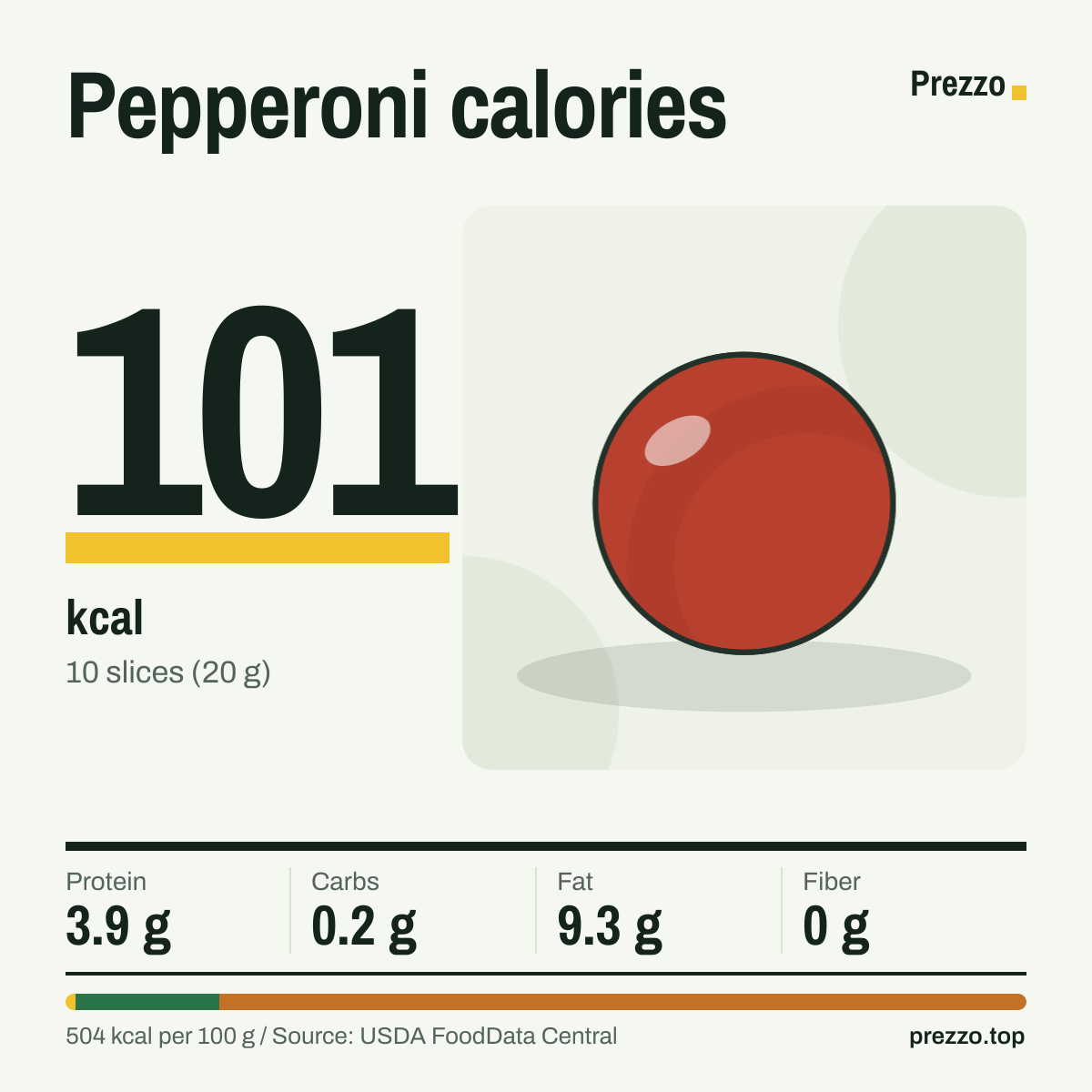
10 slices of pepperoni (20 g) have 101 calories. Per 100 g that's 504 calories, 19.3 g protein, 1.2 g carbs and 46.3 g fat.
Values for pepperoni, from USDA FoodData Central, SR Legacy (FDC 174575).
Choose a portion
Calories by portion
4 common portions of pepperoni, from 1 slice (10 calories) to 15 slices (151 calories). Weights are USDA household measures.
| Portion | Weight | Calories | Protein | Carbs | Fat |
|---|---|---|---|---|---|
| 10 slices | 20 g | 101 | 3.9 g | 0.2 g | 9.3 g |
| 1 slice | 2 g | 10 | 0.4 g | 0 g | 0.9 g |
| 15 slices | 30 g | 151 | 5.8 g | 0.4 g | 13.9 g |
| 1 oz | 28 g | 141 | 5.4 g | 0.3 g | 13 g |
| 100 g | 100 g | 504 | 19.3 g | 1.2 g | 46.3 g |
How long to burn it off
Burning off 10 slices of pepperoni (101 calories) takes about:
For a 70 kg (154 lb) adult: walking at 3 mph, cycling at 12–14 mph, running at 6 mph.
Fat supplies 84% of the calories
Of the 504 calories in 100 g of pepperoni, about 1% comes from carbohydrate, 15% from protein and 84% from fat. We count 4 kcal per gram of digestible carbs and protein, 2 per gram of fiber and 9 per gram of fat, the same factors food labels use.
Fat is what makes the number climb: 10 slices of pepperoni holds 9.3 g of fat, 3.5 g of it saturated. Gram for gram, fat carries more than twice the energy of carbohydrate or protein, so small portions of pepperoni add up quickly: 10 slices of pepperoni already comes to 101 calories.
Vitamin B12: 11% of the DV in 10 slices
10 slices of pepperoni (20 g) provides 0.3 µg of vitamin B12, 11% of the Daily Value. Per 100 g the vitamin B12 content is 1.3 µg.
Figures are for pepperoni, as analysed by the USDA.
3.9 g of protein in 10 slices
10 slices of pepperoni (20 g) provides 3.9 g of protein, 8% of the Daily Value for protein. Per 100 g the figure is 19.3 g. Measured against energy, that is 3.8 g of protein for every 100 calories; among the meats and fish on this site, cecina has 37.3 g per 100 g.
Across common portions: 10 slices give 3.9 g, 1 slice gives 0.4 g and 15 slices give 5.8 g.
Every 10 g adds 50 calories
Pepperoni has 5 calories per gram, so the portion decides the total. 1 slice (2 g) comes to 10 calories, while 15 slices (30 g) reaches 151 calories.
If you weigh your food, 100 calories of pepperoni is about 20 g. 10 slices of pepperoni (20 g), the portion most people look up, have 101 calories.
Most of the fat is unsaturated
100 g of pepperoni has 46.3 g of fat, of which 17.7 g is saturated (38%). 10 slices of pepperoni (20 g) gives 9.3 g of fat and 3.5 g saturated, 18% of the Daily Value for saturated fat.
Fat accounts for 84% of the calories, and the same portion contains 19 mg of cholesterol.
Compared with similar foods
Pepperoni next to similar meats and fish, per 100 g.
| Food | Calories | Protein | Carbs | Fat |
|---|---|---|---|---|
| Pepperoni | 504 | 19.3 g | 1.2 g | 46.3 g |
| Pork belly | 518 | 9.3 g | 0 g | 53 g |
| Bacon | 468 | 33.9 g | 1.7 g | 35.1 g |
| Foie gras | 462 | 11.4 g | 4.7 g | 43.8 g |
| Beef jerky | 410 | 33.2 g | 11 g | 25.6 g |
| Blood sausage | 379 | 14.6 g | 1.3 g | 34.5 g |
Questions people ask
How many calories are in 10 slices of pepperoni?
10 slices of pepperoni (20 g) have 101 calories. 100 g has 504 calories.
How many calories are in 100 g of pepperoni?
100 g of pepperoni has 504 calories, with 19.3 g of protein, 1.2 g of carbohydrate and 46.3 g of fat.
How much sodium is in pepperoni?
10 slices of pepperoni (20 g) have 316 mg of sodium, 14% of the Daily Value.
Is pepperoni good for weight loss?
No single food causes weight loss; your total energy intake over time decides it. At 504 calories per 100 g, pepperoni has a high energy density, and 10 slices of pepperoni is 5% of a 2,000-calorie day. This is general information, not medical advice.
Is pepperoni keto-friendly?
Yes. 10 slices of pepperoni (20 g) have only 0.2 g of net carbs, which fits easily into a typical keto limit of 20–50 g a day.
How much protein is in pepperoni?
10 slices of pepperoni (20 g) have 3.9 g of protein. Per 100 g: 19.3 g.
Similar foods
Pepperoni calories at a glance
Sources and method
Nutrient values: USDA FoodData Central, SR Legacy, FDC 174575, retrieved 2026-11-18. Portion weights: USDA and AUSNUT household measures or standard container sizes. Percentages use the FDA Daily Values (2,000-calorie diet). Glycemic index: International Tables (Atkinson et al., 2021). How we calculate these numbers