How Many Calories in Cider?
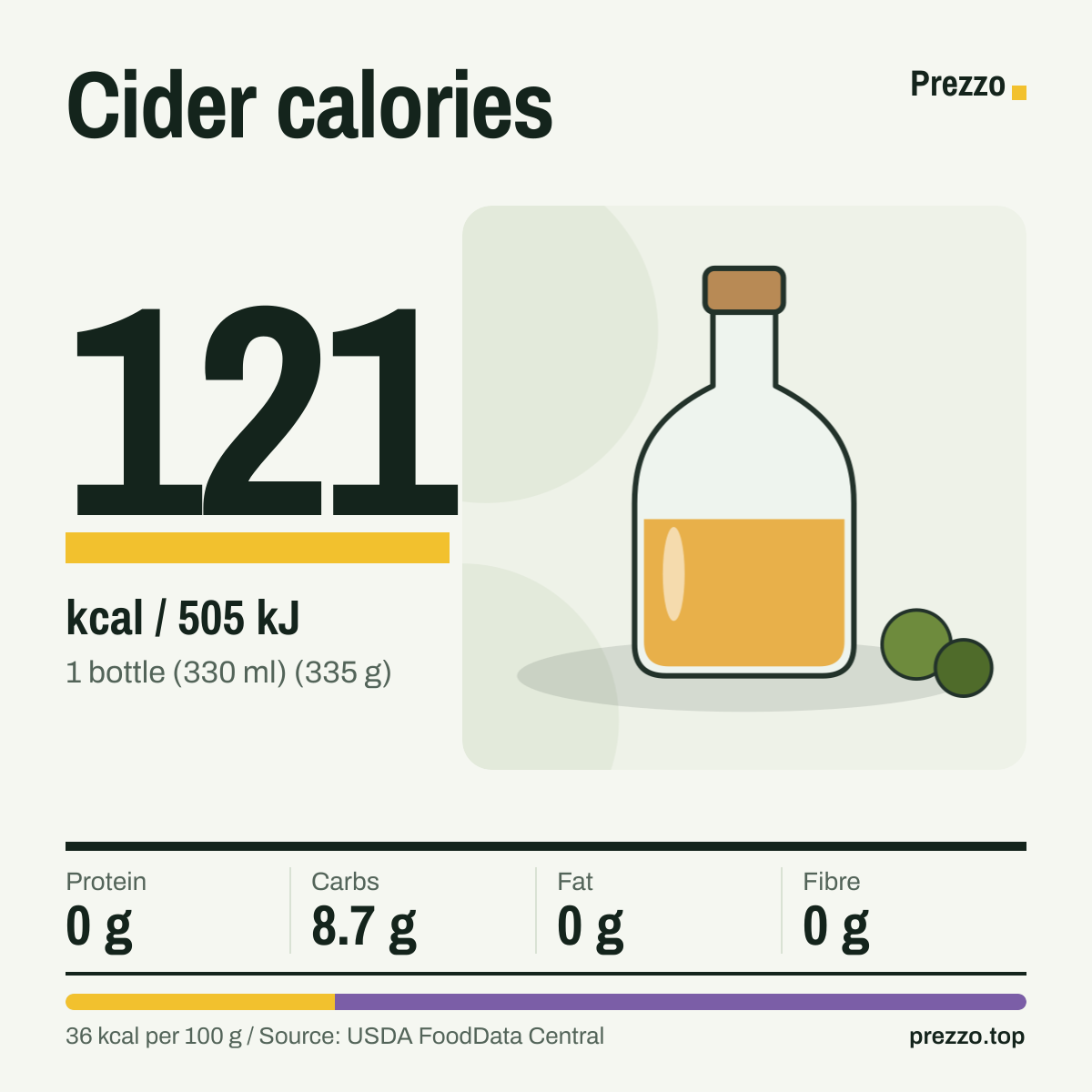
A bottle of cider (330 ml) (335 g) have 121 calories (505 kJ). Per 100 g that's 36 calories (151 kJ), 0 g protein, 2.6 g carbs and 0 g fat.
Values for cider, from UK CoFID, McCance and Widdowson's (CoFID 17-222).
Choose a portion
Calories by portion
3 common portions of cider, from 1 glass (250 ml) (91 kcal) to 1 bottle (500 ml) (183 kcal). Weights are USDA household measures.
| Portion | Weight | Calories | kJ | Protein | Carbs | Fat |
|---|---|---|---|---|---|---|
| 1 bottle (330 ml) | 335 g | 121 | 505 | 0 g | 8.7 g | 0 g |
| 1 glass (250 ml) | 254 g | 91 | 383 | 0 g | 6.6 g | 0 g |
| 1 bottle (500 ml) | 507 g | 183 | 764 | 0 g | 13.2 g | 0 g |
| 100 g | 100 g | 36 | 151 | 0 g | 2.6 g | 0 g |
How long to burn it off
Burning off a bottle of cider (330 ml) (121 kcal) takes about:
For a 70 kg adult: walking at 5 km/h, cycling at 20 km/h, running at 10 km/h.
Alcohol supplies 72% of the calories
Of the 36 calories (151 kJ) in 100 g of cider, about 28% comes from carbohydrate, 0% from protein and 0% from fat, and 72% from alcohol. We count 4 kcal per gram of digestible carbs and protein, 2 per gram of fibre and 9 per gram of fat, the same factors food labels use.
Alcohol has 7 kcal per gram, so most of the energy in a bottle of cider (330 ml) comes from its 12.7 g of alcohol rather than from carbohydrate (8.7 g) or protein (0 g). The total comes to 121 calories (505 kJ).
Potassium: 12% of the RI in 1 bottle (330 ml)
A bottle of cider (330 ml) (335 g) provides 241 mg of potassium, 12% of the reference intake. It also supplies 1.7 mg of iron (12%). Per 100 g the potassium content is 72 mg.
Figures are for cider, as analysed by the USDA.
Every 10 g adds 3.6 calories
Cider has 0.4 calories per gram, so the portion decides the total. 1 glass (250 ml) (254 g) comes to 91 calories (383 kJ), while 1 bottle (500 ml) (507 g) reaches 183 calories (764 kJ).
If you weigh your food, 100 calories of cider is about 278 g. A bottle of cider (330 ml) (335 g), the portion most people look up, have 121 calories (505 kJ).
Practically sodium-free: 7 mg per 100 g
A bottle of cider (330 ml) (335 g) has 23 mg of sodium and 241 mg of potassium. Potassium outweighs sodium by roughly 10 to 1, the opposite of most processed foods.
Salt only becomes a factor if you add it or eat cider in a salted dish.
Lower in calories than most drinks
At 36 calories (151 kJ) per 100 g, cider ranks 14 of 60 drinks on this site, counted from the lowest. The group median is 54 calories (226 kJ) per 100 g; the lowest is black coffee (1) and the highest Irish cream liqueur (305).
A bottle of cider (330 ml) (335 g) is 6% of a 2,000-calorie reference day.
Compared with similar foods
Cider next to similar drinks, per 100 g.
| Food | Calories | Protein | Carbs | Fat |
|---|---|---|---|---|
| Cider | 36 | 0 g | 2.6 g | 0 g |
| Stout | 37 | 0.4 g | 3.2 g | 0 g |
| Non-alcoholic beer | 37 | 0.2 g | 8.1 g | 0.1 g |
| Tonic water | 34 | 0 g | 8.8 g | 0 g |
| Ginger ale | 34 | 0 g | 8.8 g | 0 g |
| Grapefruit juice | 39 | 0.5 g | 9.2 g | 0.1 g |
Questions people ask
How many calories are in a bottle of cider (330 ml)?
A bottle of cider (330 ml) (335 g) have 121 calories (505 kJ). 100 g has 36 calories (151 kJ).
How many calories are in 100 g of cider?
100 g of cider has 36 calories (151 kJ), with 0 g of protein, 2.6 g of carbohydrate and 0 g of fat.
How much sugar is in cider?
A bottle of cider (330 ml) (335 g) have 8.7 g of sugar. 100 g has 2.6 g.
Is cider good for weight loss?
No single food causes weight loss; your total energy intake over time decides it. At 36 calories (151 kJ) per 100 g, cider has a low energy density, and a bottle of cider (330 ml) is 6% of a 2,000-calorie day. This is general information, not medical advice.
How many carbs are in cider?
A bottle of cider (330 ml) (335 g) have 8.7 g of carbohydrate, including 0 g of fibre, so 8.7 g net carbs. Per 100 g: 2.6 g.
What vitamins and minerals does cider have?
A bottle of cider (330 ml) (335 g) gives 241 mg of potassium (12% RI) and 1.7 mg of iron (12% RI).
Similar foods
Cider calories at a glance
Sources and method
Nutrient values: UK CoFID, McCance and Widdowson's, CoFID 17-222, retrieved 2026-11-18. Portion weights: USDA and AUSNUT household measures or standard container sizes. Percentages use the EU/UK reference intakes. Glycemic index: International Tables (Atkinson et al., 2021). How we calculate these numbers