How Many Calories in a Tuna Roll?
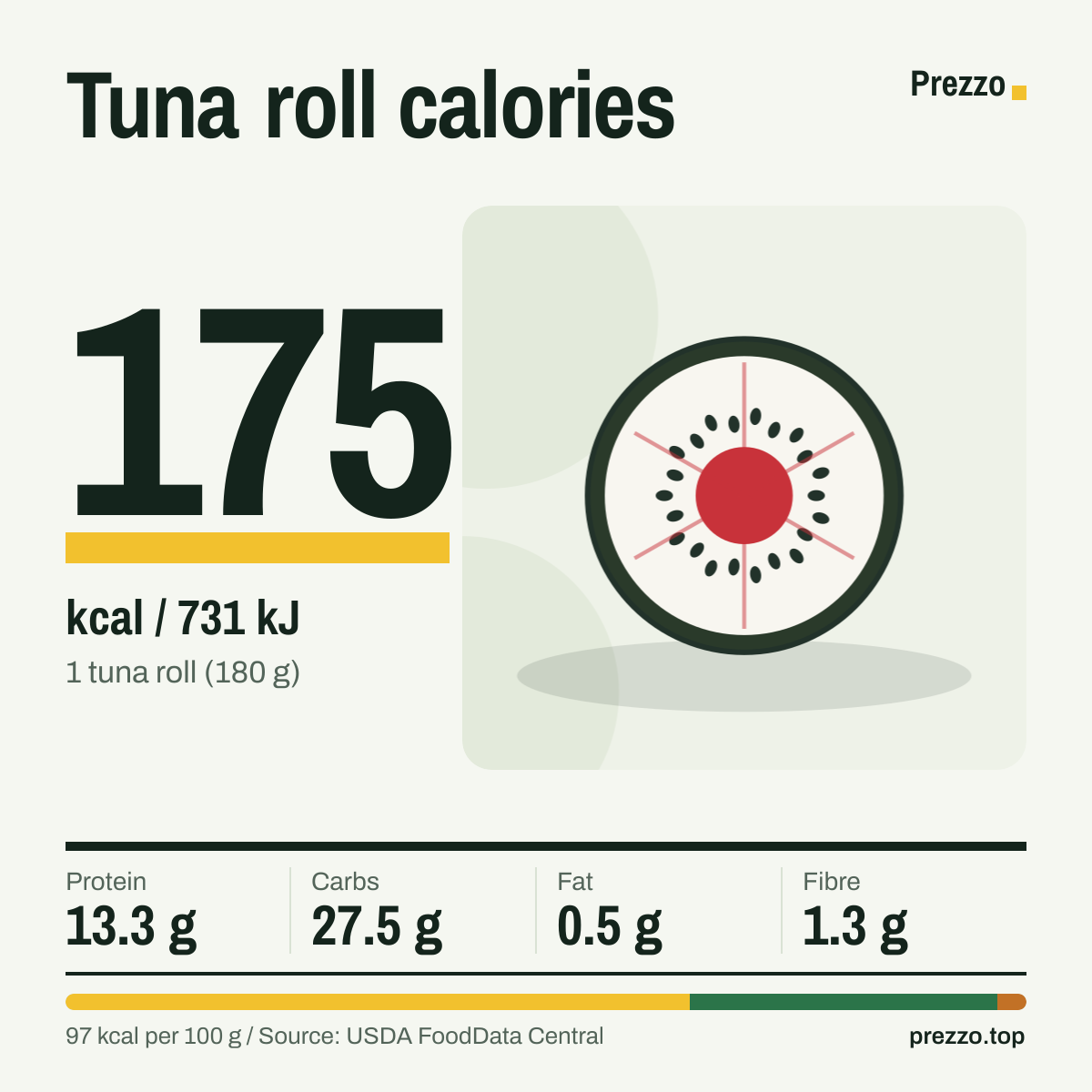
A tuna roll (180 g) has 175 calories (731 kJ). Per 100 g that's 97 calories (406 kJ), 7.4 g protein, 15.3 g carbs and 0.9 g sugar.
Values for tuna roll, from USDA FoodData Central, FNDDS (FDC 2708965).
Choose a portion

Calories by portion
4 common portions of tuna roll, from 1 slice (29 kcal) to 2 tuna rolls (349 kcal). Weights are USDA household measures.
| Portion | Weight | Calories | kJ | Protein | Carbs | Fat |
|---|---|---|---|---|---|---|
| 1 tuna roll | 180 g | 175 | 731 | 13.3 g | 27.5 g | 0.5 g |
| 1 slice | 30 g | 29 | 122 | 2.2 g | 4.6 g | 0.1 g |
| ½ tuna roll | 90 g | 87 | 365 | 6.7 g | 13.8 g | 0.2 g |
| 2 tuna rolls | 360 g | 349 | 1,461 | 26.6 g | 55.1 g | 0.9 g |
| 100 g | 100 g | 97 | 406 | 7.4 g | 15.3 g | 0.3 g |
One tuna roll weighs about 180 g.
How long to burn it off
Burning off a tuna roll (175 kcal) takes about:
For a 70 kg adult: walking at 5 km/h, cycling at 20 km/h, running at 10 km/h.
Carbs supply 65% of the calories
Of the 97 calories (406 kJ) in 100 g of tuna roll, about 65% comes from carbohydrate, 32% from protein and 3% from fat. We count 4 kcal per gram of digestible carbs and protein, 2 per gram of fibre and 9 per gram of fat, the same factors food labels use.
That makes tuna roll a carbohydrate food first: a tuna roll carries 27.5 g of carbohydrate, 1.7 g of it sugar. Protein (13.3 g) and fat (0.5 g) barely move the total of 175 calories (731 kJ).
Vitamin B12: 37% of the RI in 1 tuna roll
A tuna roll (180 g) provides 0.9 µg of vitamin B12, 37% of the reference intake. It also supplies 0.44 mg of vitamin B6 (32%) and 0.7 µg of vitamin D (14%). Per 100 g the vitamin B12 content is 0.5 µg.
Figures are for tuna roll, as analysed by the USDA.
Almost none of the carbs are sugar
100 g of tuna roll has 15.3 g of carbohydrate: 0.9 g sugar, 0.7 g fibre and 13.7 g of starch and other carbohydrates.
A tuna roll (180 g) therefore gives 26.3 g of net carbs (total carbs minus fibre) and 1.3 g of fibre, 5% of the reference intake.
Every 10 g adds 9.7 calories
Tuna roll has 1 calories per gram, so the portion decides the total. 1 slice (30 g) comes to 29 calories (122 kJ), while 2 tuna rolls (360 g) reaches 349 calories (1,461 kJ).
If you weigh your food, 100 calories of tuna roll is about 103 g. A tuna roll (180 g), the portion most people look up, has 175 calories (731 kJ).
Sodium is the row to watch: 616 mg per tuna roll
A tuna roll (180 g) contains 616 mg of sodium, equal to 1.5 g of salt and 26% of the reference intake. Per 100 g it is 342 mg.
That is more sodium than 42 of the 126 other dishes on this site. Two portions would reach 52% of the daily reference intake, so it is worth counting if you watch salt.
Compared with similar foods
Tuna roll next to similar dishes, per 100 g.
| Food | Calories | Protein | Carbs | Fat |
|---|---|---|---|---|
| Tuna roll | 97 | 7.4 g | 15.3 g | 0.3 g |
| Beef stew | 99 | 4.4 g | 7.9 g | 5.5 g |
| Sushi | 94 | 2.9 g | 18.4 g | 0.7 g |
| California roll | 94 | 2.9 g | 18.4 g | 0.7 g |
| Chicken biryani | 104 | 7.2 g | 13.6 g | 2.4 g |
| Potato soup | 90 | 1.5 g | 10.5 g | 4.7 g |
Questions people ask
How many calories are in a tuna roll?
A tuna roll (180 g) has 175 calories (731 kJ). 100 g has 97 calories (406 kJ).
How many calories are in 100 g of tuna roll?
100 g of tuna roll has 97 calories (406 kJ), with 7.4 g of protein, 15.3 g of carbohydrate and 0.3 g of fat.
How many calories are in 2 tuna rolls?
Two tuna rolls (360 g) have 349 calories (1,461 kJ).
How much protein is in a tuna roll?
A tuna roll (180 g) has 13.3 g of protein. Per 100 g: 7.4 g.
Is tuna roll keto-friendly?
Not really. A tuna roll (180 g) has 26.3 g of net carbs, which uses up most of a typical 20–50 g daily keto limit.
How much fat is in a tuna roll?
A tuna roll (180 g) has 0.5 g of fat, 0.1 g of it saturated. Per 100 g: 0.3 g.
Similar foods
Tuna roll calories at a glance
Sources and method
Nutrient values: USDA FoodData Central, FNDDS, FDC 2708965, retrieved 2026-11-18. Portion weights: USDA and AUSNUT household measures or standard container sizes. Percentages use the EU/UK reference intakes. Glycemic index: International Tables (Atkinson et al., 2021). How we calculate these numbers