How Many Calories in Brie?
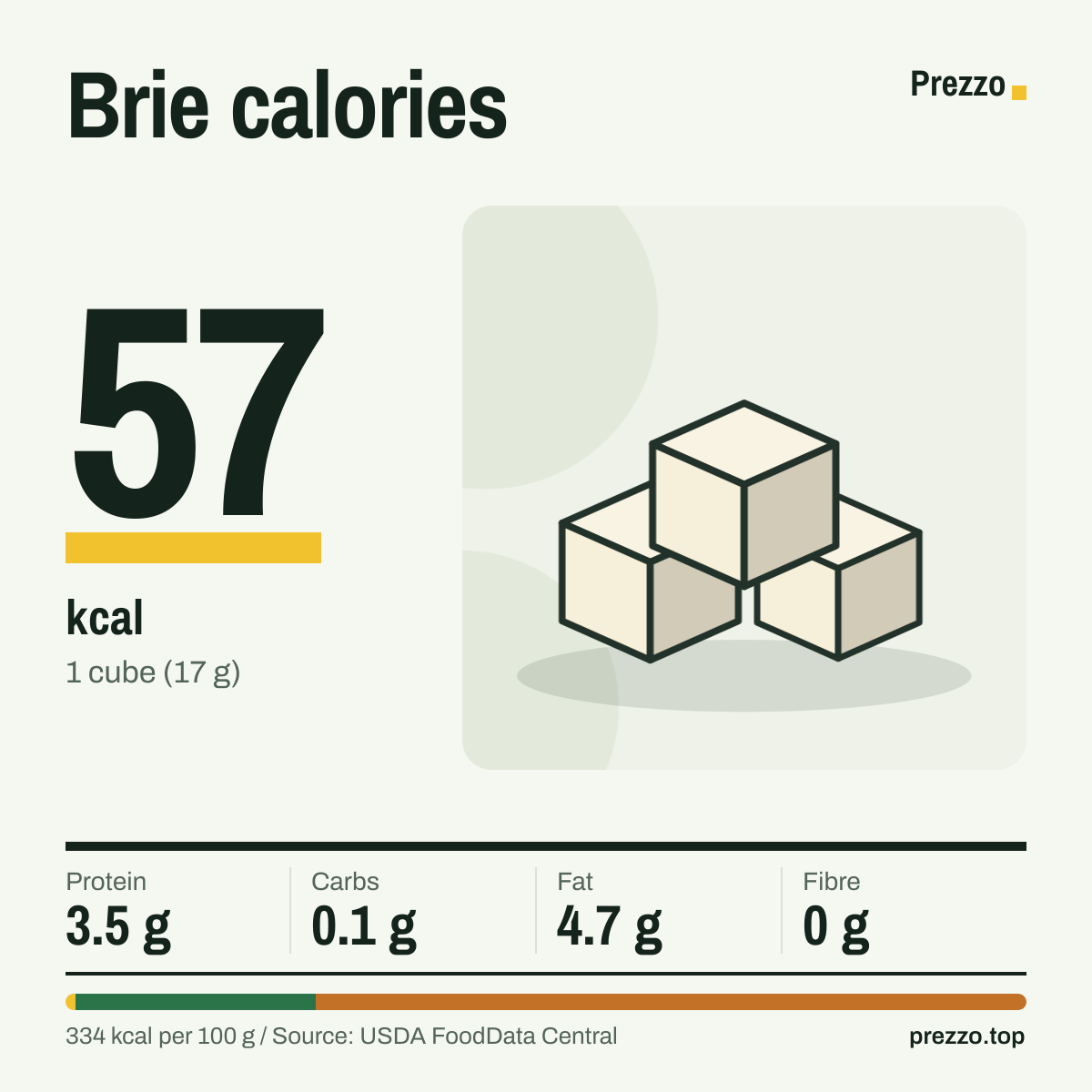
1 cube of brie (17 g) has 57 kcal. Per 100 g that's 334 kcal, 20.8 g protein, 0.5 g carbs and 27.7 g fat.
Values for brie, from USDA FoodData Central, SR Legacy (FDC 172177).
Choose a portion

Calories by portion
3 common portions of brie, from 1 cube (57 kcal) to 1 small brie (428 kcal). Weights are USDA household measures.
| Portion | Weight | kcal | Protein | Carbs | Fat |
|---|---|---|---|---|---|
| 1 cube | 17 g | 57 | 3.5 g | 0.1 g | 4.7 g |
| 1 serving | 30 g | 100 | 6.2 g | 0.1 g | 8.3 g |
| 1 small brie | 128 g | 428 | 26.6 g | 0.6 g | 35.4 g |
| 100 g | 100 g | 334 | 20.8 g | 0.5 g | 27.7 g |
How long to burn it off
Burning off 1 cube of brie (57 kcal) takes about:
For a 70 kg adult: walking at 5 km/h, cycling at 20 km/h, running at 10 km/h.
Fat supplies 74% of the calories
Of the 334 kcal in 100 g of brie, about 1% comes from carbohydrate, 25% from protein and 74% from fat. We count 4 kcal per gram of digestible carbs and protein, 2 per gram of fibre and 9 per gram of fat, the same factors food labels use.
Fat is what makes the number climb: 1 cube of brie holds 4.7 g of fat, 3 g of it saturated. Gram for gram, fat carries more than twice the energy of carbohydrate or protein, so small portions of brie add up quickly: 1 cube of brie already comes to 57 kcal.
Vitamin B12: 11% of the RI in 1 cube
1 cube of brie (17 g) provides 0.3 µg of vitamin B12, 11% of the reference intake. Per 100 g the vitamin B12 content is 1.7 µg.
Figures are for brie, as analysed by the USDA.
3.5 g of protein in 1 cube
1 cube of brie (17 g) provides 3.5 g of protein, 7% of the reference intake for protein. Per 100 g the figure is 20.8 g. Measured against energy, that is 6.2 g of protein for every 100 calories; among the dairy foods on this site, Parmesan has 35.8 g per 100 g.
Across common portions: 1 cube gives 3.5 g, 1 serving gives 6.2 g and 1 small brie gives 26.6 g.
Every 10 g adds 33 calories
Brie has 3.3 calories per gram, so the portion decides the total. 1 cube (17 g) comes to 57 kcal, while 1 small brie (128 g) reaches 428 kcal.
If you weigh your food, 100 calories of brie is about 30 g. 1 cube of brie (17 g), the portion most people look up, has 57 kcal.
63% of the fat is saturated
100 g of brie has 27.7 g of fat, of which 17.4 g is saturated (63%). 1 cube of brie (17 g) gives 4.7 g of fat and 3 g saturated, 15% of the reference intake for saturated fat.
Fat accounts for 74% of the calories, and the same portion contains 17 mg of cholesterol.
Compared with similar foods
Brie next to similar dairy foods, per 100 g.
| Food | kcal | Protein | Carbs | Fat |
|---|---|---|---|---|
| Brie | 334 | 20.8 g | 0.5 g | 27.7 g |
| Whipping cream | 340 | 2.8 g | 2.8 g | 36.1 g |
| Egg yolk | 322 | 15.9 g | 3.6 g | 26.5 g |
| Condensed milk | 321 | 7.9 g | 54.4 g | 8.7 g |
| Cream cheese | 350 | 6.2 g | 5.5 g | 34.4 g |
| Provolone | 351 | 25.6 g | 2.1 g | 26.6 g |
Questions people ask
How many calories are in 1 cube of brie?
1 cube of brie (17 g) has 57 kcal. 100 g has 334 kcal.
How many calories are in 100 g of brie?
100 g of brie has 334 kcal, with 20.8 g of protein, 0.5 g of carbohydrate and 27.7 g of fat.
Is brie good for weight loss?
No single food causes weight loss; your total energy intake over time decides it. At 334 kcal per 100 g, brie has a high energy density, and 1 cube of brie is 3% of a 2,000-calorie day. This is general information, not medical advice.
How much protein is in brie?
1 cube of brie (17 g) has 3.5 g of protein. Per 100 g: 20.8 g.
How many carbs are in brie?
1 cube of brie (17 g) has 0.1 g of carbohydrate, including 0 g of fibre, so 0.1 g net carbs. Per 100 g: 0.5 g.
How much fat is in brie?
1 cube of brie (17 g) has 4.7 g of fat, 3 g of it saturated. Per 100 g: 27.7 g.
Similar foods
Brie calories at a glance
Sources and method
Nutrient values: USDA FoodData Central, SR Legacy, FDC 172177, retrieved 2026-11-18. Portion weights: USDA and AUSNUT household measures or standard container sizes. Percentages use the EU/UK reference intakes. Glycemic index: International Tables (Atkinson et al., 2021). How we calculate these numbers