How Many Calories in Kale?
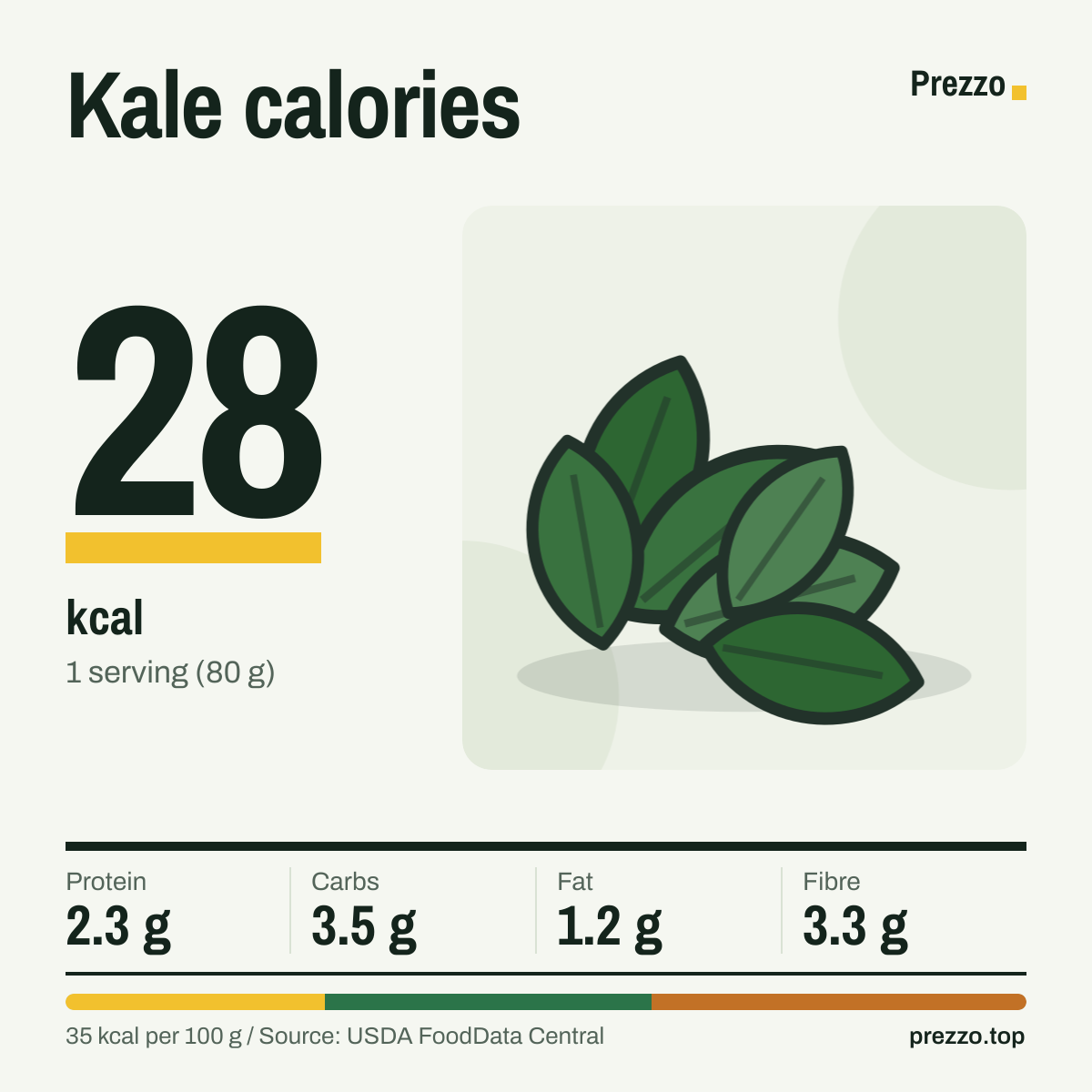
1 serving of kale (80 g) has 28 kcal. Per 100 g that's 35 kcal, 2.9 g protein, 4.4 g carbs and 1.5 g fat.
Values for raw kale, from USDA FoodData Central, SR Legacy (FDC 168421).
Choose a portion

Calories by portion
3 common portions of kale, from 1 small serving (14 kcal) to 1 large serving (53 kcal). Weights are USDA household measures.
| Portion | Weight | kcal | Protein | Carbs | Fat |
|---|---|---|---|---|---|
| 1 serving | 80 g | 28 | 2.3 g | 3.5 g | 1.2 g |
| 1 large serving | 150 g | 53 | 4.4 g | 6.6 g | 2.2 g |
| 1 small serving | 40 g | 14 | 1.2 g | 1.8 g | 0.6 g |
| 100 g | 100 g | 35 | 2.9 g | 4.4 g | 1.5 g |
Preparation
The same food, prepared 2 ways. Values per 100 g and for 1 serving.
| Preparation | kcal / 100 g | 1 serving | Protein | Carbs | Fat |
|---|---|---|---|---|---|
| Raw kale | 35 | 28 | 2.9 g | 4.4 g | 1.5 g |
| Boiled kale | 36 | 29 | 2.9 g | 5.3 g | 1.2 g |
How long to burn it off
Burning off 1 serving of kale (28 kcal) takes about:
For a 70 kg adult: walking at 5 km/h, cycling at 20 km/h, running at 10 km/h.
Fat supplies 39% of the calories
Of the 35 kcal in 100 g of kale, about 27% comes from carbohydrate, 34% from protein and 39% from fat. We count 4 kcal per gram of digestible carbs and protein, 2 per gram of fibre and 9 per gram of fat, the same factors food labels use.
Fat is what makes the number climb: 1 serving of kale holds 1.2 g of fat, 0.1 g of it saturated. Gram for gram, fat carries more than twice the energy of carbohydrate or protein, so small portions of kale add up quickly: 1 serving of kale already comes to 28 kcal.
Preparation changes the number: 35–36 calories per 100 g
Raw kale has 35 kcal per 100 g and boiled kale has 36 kcal per 100 g.
The gap between raw kale and boiled kale is 1 calories per 100 g, mostly from water: cooking, drying or soaking changes how much water each 100 g holds. Log the version you actually eat.
Vitamin K: 416% of the RI in 1 serving
1 serving of kale (80 g) provides 312 µg of vitamin K, 416% of the reference intake. It also supplies 75 mg of vitamin C (93%) and 203 mg of calcium (25%). Per 100 g the vitamin K content is 390 µg.
Figures are for raw kale, as analysed by the USDA.
Every 10 g adds 3.5 calories
Kale has 0.4 calories per gram, so the portion decides the total. 1 small serving (40 g) comes to 14 kcal, while 1 large serving (150 g) reaches 53 kcal.
If you weigh your food, 100 calories of kale is about 286 g. 1 serving of kale (80 g), the portion most people look up, has 28 kcal.
Higher in calories than most vegetables
At 35 kcal per 100 g, kale ranks 46 of 72 vegetables on this site, counted from the lowest. The group median is 28 kcal per 100 g; the lowest is watercress (11) and the highest cassava (160).
1 serving of kale (80 g) is 1% of a 2,000-calorie reference day.
Compared with similar foods
Kale next to similar vegetables, per 100 g.
| Food | kcal | Protein | Carbs | Fat |
|---|---|---|---|---|
| Kale | 35 | 2.9 g | 4.4 g | 1.5 g |
| Green beans | 35 | 1.9 g | 7.9 g | 0.3 g |
| Broccoli | 34 | 2.8 g | 6.6 g | 0.4 g |
| Brussels sprouts | 36 | 2.6 g | 7.1 g | 0.5 g |
| Spring onion | 32 | 1.8 g | 7.3 g | 0.2 g |
| Red cabbage | 31 | 1.4 g | 7.4 g | 0.2 g |
Questions people ask
How many calories are in 1 serving of kale?
1 serving of kale (80 g) has 28 kcal. 100 g has 35 kcal.
How many calories are in 100 g of kale?
100 g of raw kale has 35 kcal, with 2.9 g of protein, 4.4 g of carbohydrate and 1.5 g of fat.
Does cooking change the calories in kale?
Per 100 g: raw kale 35 and boiled kale 36 calories. The difference comes from added fat or from water lost or gained.
How much protein is in kale?
1 serving of kale (80 g) has 2.3 g of protein. Per 100 g: 2.9 g.
What vitamins and minerals does kale have?
1 serving of kale (80 g) gives 312 µg of vitamin K (416% RI), 75 mg of vitamin C (93% RI) and 203 mg of calcium (25% RI).
How many carbs are in kale?
1 serving of kale (80 g) has 3.5 g of carbohydrate, including 3.3 g of fibre, so 0.3 g net carbs. Per 100 g: 4.4 g.
Similar foods
Kale calories at a glance
Sources and method
Nutrient values: USDA FoodData Central, SR Legacy, FDC 168421, retrieved 2026-11-18. Portion weights: USDA and AUSNUT household measures or standard container sizes. Percentages use the EU/UK reference intakes. Glycemic index: International Tables (Atkinson et al., 2021). How we calculate these numbers